Steel Testing Laboratory
  • Home
  • Metal Testing
    • Mechanical Testing >
      • Tensile Testing
      • Charpy Impact Testing
      • Hardness Testing
      • Guided Bend Testing
    • Chemical Analysis OES PMI
    • Metallurgical Testing
    • Induction Bend Testing
    • Drop Weight Tear Test
    • Weld Testing
  • Industries Served
    • Defense Industry Testing
    • Foundry Castings
    • Oil & Gas >
      • PHMSA Mega Rule Testing
    • Petrochem
    • Shipbuilding
    • Welding & Fabrication
  • Company
    • Quality Management
    • News
    • Clients
  • Specimen Machining
  • Contact Us

Charpy Impact Testing

How ductile is your material at service temperature?
Quick Quote!

1-888-611-3076

Charpy Impact Testing Services

Broken charpy impact test specimens

Historical Significance

Historically, the impact testing was developed in the 19th century to address brittle failures which caused catastrophic accidents in the railway industry.  Over time, the test was refined with the development of equipment that could measure absorbed energy as well as standardization of the specimen size and notch geometry. 

While the written standard was tentatively introduced in the 1930's, it was not commonly adopted in material specifications until after 1948 when a report was released establishing the correlation between the impact properties of fractured plates and the likelihood of brittle fracture due to the many failures that occurred to the Liberty cargo ships used in WWII.

The results provided by the charpy impact test were often scattered, and somewhat unreliable, until it was determined that machine maintenance and regular testing could dramatically tighten the margin of error of the results.  Thus, the indirect verification method was instituted. 

Specimen Machining & Testing Capability

High quality specimen preparation directly affects data integrity.  Quality Testing, Inc. is capable of producing charpy specimens as small as 3 mm thick with our using our in-house machine shop equipped with state-of-the-art CNC machines.  We hold tolerances within +/- 0.001", and inspect the accuracy of our notch geometry using an optical comparator.

We can test charpy v-notch specimens at temperatures between
-320ºF to 200ºF and generating up to 300 ft. lbs. of energy.  Once the v-notch impact specimens are broken we can measure shear percentage and lateral expansion. 

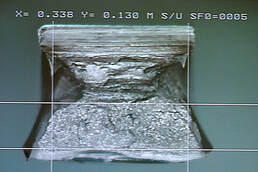
Often shear percentage is measured using the "eyeball" method. We have developed a way to quickly and accurately evaluate shear using a calibrated video measurement system, taking the guess work out of the equation.

Let us quote your job for charpy impact testing services to determine if your material is ductile at your required service temperature.


How to Perform a Charpy Impact Test (Step-by-Step)

Following ASTM E23 guidelines, here’s a simplified checklist for running a Charpy impact test:
✅ Step 1: Prepare the Specimens
  • Machine specimens to standard dimensions (typically 10 × 10 × 55 mm with a V-notch).
  • Verify notch dimensions for accuracy
✅ Step 2: Inspect and Verify the Machine
  • Check pendulum, anvils, and striker for wear or damage.
  • Perform free swing check
✅ Step 3: Control the Test Temperature
  • Condition specimens in a liquid bath or gas medium to the target temperature (room temp: 20 ± 5 °C)
✅ Step 4: Position the Specimen
  • Place the specimen flat on the anvils, notch facing away from the pendulum striker.
  • Use self-centering tongs to avoid misalignment.
✅ Step 5: Release the Pendulum
  • Raise pendulum to latched position, set energy indicator.
  • Release smoothly without vibration.
  • Record absorbed energy from the machine scale 
✅ Step 6: Record and Report Data
  • Report absorbed energy
  • Note test temperature, specimen orientation, and fracture appearance (percent shear).
  • If lateral expansion is measured, use a dial-gage method to calculate bulging.
Pro Tips for Reliable Results
  • Prepare samples per specification requirements.
  • Keep detailed logbooks of sample specimen dimensions
  • Never strike a specimen more than once.
  • For ductile-to-brittle transition studies, test across a temperature range.

Quick Quote!

Frequently Asked Questions (FAQs) on Charpy Impact Testing

What does the Charpy impact test measure?
The Charpy impact test measures the energy absorbed by a notched specimen when struck by a swinging pendulum. This value indicates a material’s toughness and its ability to resist brittle fracture.

Why is Charpy impact testing important?
Charpy testing is important because it helps predict real-world material performance under sudden forces at service temperature. It identifies whether a material will behave in a ductile (bend before breaking) or brittle (shatter suddenly) manner, ensuring safety in industries like construction, aerospace, and energy.

What is ASTM E23?
ASTM E23 is the international standard that governs Charpy and Izod impact testing of metallic materials. It specifies specimen dimensions, test machine requirements, procedures, and reporting criteria to ensure consistent and reliable results.

What is the difference between Charpy and Izod tests?
Both are notched bar impact tests, but the setup is different. In the Charpy test, the specimen is supported at both ends like a simple beam. In the Izod test, the specimen is clamped vertically like a cantilever beam. Charpy is more widely used for structural metals.

At what temperatures are Charpy tests performed?
Charpy tests can be performed at room temperature (72 ± 5 °F) or at controlled high or low temperatures depending on application needs. Testing at different temperatures reveals the ductile-to-brittle transition of materials, especially steels.
Broken charpy impact specimen being measured for percent shear
Quality Testing uses a video imaging system with an x/y controller to accurately measure percent shear according to ASTM E23

Other Testing Services

• Tensile Testing
• Hardness Testing
• Chemical Composition Analysis
• Case Depth Analysis
• Grain Size Analysis
• Microstructure Analysis
• Drop Weight Tear Testing

Test Standards

• ASTM
• ASME
• AWS
• API
• & Others

Certs & Systems

• ISO 9001 certified
• ABS Approved
• Personal Customer Service
• On-Time Delivery Tracking
• Complete Traceability


Charpy Impact Testing Laboratory

 Quick Links

Company
  • News
  • Clients
  • Testimonials
Testing Services
  • Mechanical Testing
  • Weld Testing
  • Chemical Analysis
Resources
  • Glossary
  • Abbreviations
  • Site Map


Connect
  • 1-888-611-3076
  • Quick RFQ
  • Contact

Standard Hours of Operation

Monday - Friday:  7 AM - 3:30 PM

 Quality Testing, Inc.,1832 Wooddale Blvd., Baton Rouge, Louisiana 70806
© 2025 All rights reserved.

  • Home
  • Metal Testing
    • Mechanical Testing >
      • Tensile Testing
      • Charpy Impact Testing
      • Hardness Testing
      • Guided Bend Testing
    • Chemical Analysis OES PMI
    • Metallurgical Testing
    • Induction Bend Testing
    • Drop Weight Tear Test
    • Weld Testing
  • Industries Served
    • Defense Industry Testing
    • Foundry Castings
    • Oil & Gas >
      • PHMSA Mega Rule Testing
    • Petrochem
    • Shipbuilding
    • Welding & Fabrication
  • Company
    • Quality Management
    • News
    • Clients
  • Specimen Machining
  • Contact Us